Wong Kar-wai’s films are dark. The dark is in color.
Wong Kar-wai’s films are known for saturated color: the red of In the Mood for Love, the green of Days of Being Wild. We measured every second of his 10 features, from As Tears Go By (1988) to The Grandmaster (2013), to see how saturated they are next to other films of the same years. By the main color of each frame, which is what we count in every post, they are not: 16% strong color, against 13% for other films. What sets them apart is the dark. Near black is the main color for 41% of the average one, against 28%, and 73% of those dark frames still have color in them.
- 41% of the average Wong Kar-wai film is near black, against 28% for other films
- 29% is a near-black frame with color in it, against 14%
- 16% strong color, against 13% for other films: within chance
Upper bareach second’s main color Lower barthe same seconds, by the average color of the whole frame
- As Tears Go By 1988

 42%
- Days of Being Wild 1990

 59%
- Chungking Express 1994

 20%
- Ashes of Time 1994

 19%
- Fallen Angels 1995

 54%
- Happy Together 1997

 18%
- In the Mood for Love 2000

 54%
- 2046 2004

 55%
- My Blueberry Nights 2007

 33%
- The Grandmaster 2013

 59%
By the main color, no more saturated than other films
Every post here starts from one measurement: the main color of each second, the largest area of one color in the frame. A second is strongly colored when that color is clearly saturated. By that count the average Wong Kar-wai film is strongly colored for 16% of the seconds we measure. The 723 other live-action color films of 1988 to 2013 in Fade to Color average 13%, a difference well within chance (p = 0.55).
The range is wide. Ashes of Time (1994), set in a desert, is strongly colored for 52% of its length. Days of Being Wild (1990), the green one, is at 3%: its green is a dim tint, not a saturated color.
Near black for 41% of the running time
That count leaves something out. In every post we set aside the seconds whose main color is close to black, because black has no hue to measure. In other films of these years that is 28% of the running time. In Wong Kar-wai’s it is 41% (p = 0.01).
Five of the 10 are near black for more than half their length: Days of Being Wild (59%), The Grandmaster (59%), 2046 (55%), In the Mood for Love (54%) and Fallen Angels (54%). Of the 723 other films, 12% are. Not all 10 are dark: Chungking Express (1994), Ashes of Time and Happy Together (1997) are each near black for about a fifth of their length, less than the average film.
The dark is in color
Near black describes the largest area in the frame, not all of it. So for the seconds we had set aside we took a second measurement: the average color of the whole frame. If the frame is black all over, that average is a dark gray. If part of it is lit in color, the average takes on the color.
In other films, 53% of the near-black seconds have an average that is not gray. In Wong Kar-wai’s, 73% do (p = 0.003). Together with how dark the films are, that makes 29% of the average one a near-black frame with color in it. In other films it is 14% (p < 0.001). Nine of the 10 are above that figure.
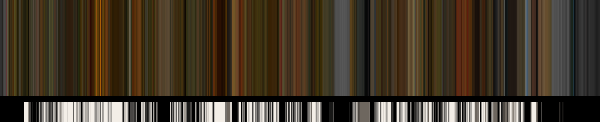
Fallen Angels (1995) and In the Mood for Love (2000) are equally dark, each 54% near black. Each strip is a whole film, first frame on the left and credits on the right, in the average color of each moment. The band underneath marks the near-black seconds: white where the frame as a whole has color, gray where it does not.
Fallen Angels 1995
45% color in the dark
In the Mood for Love 2000
21% color in the dark
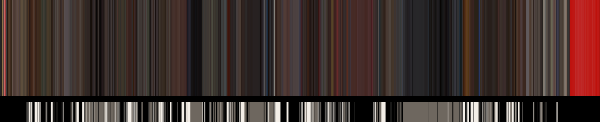
In Fallen Angels, 84% of the dark has color in it. In In the Mood for Love, 39% does: the least of the 10, and less than in the average film. The film this post began with has the blackest dark of the 10.
More than any other director we can measure
We ran the same count for every director with eight or more live-action color films in Fade to Color. There are 23, and Wong Kar-wai is first. Next are David Fincher (25%) and Martin Scorsese (25%), whose films are about as dark as his. Fincher’s are near black for 46% of their length, the most of anyone’s. But less of their dark has color in it: 55% and 58%, against 73%.
Count only dark frames that are strongly colored as a whole, and he is still first: 10% of the running time, against 3% for other films of his years (p = 0.005).
So are his films saturated?
As whole frames, yes. Take the average color of every frame, dark or not, and the average Wong Kar-wai film is strongly colored for 29% of its running time. Other films are for 16% (p = 0.02). Of the 23 directors he is fourth by that count, after Wes Anderson, Zhang Yimou and Steven Soderbergh.
The gap between the two counts is the finding. By the main color, strong color fills 11% of his films’ running time, near-black seconds included. By the average color it fills 29%. For other films the two figures are 10% and 16%. In a Wong Kar-wai film the color is in the frame, but it is usually not the largest thing in it. Something darker is.
No palette in common
What the 10 do not share is a palette. Here is each one as a flower of its seconds that are not near black, all at one scale.
- 1988 Andrew Lau
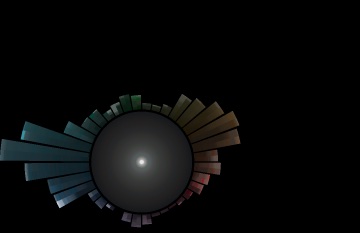
As Tears Go By 1988
42% near black
20% blue- 1990 to 2004 Christopher Doyle, alone or with others
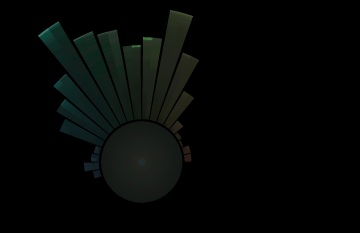
Days of Being Wild 1990
59% near black
42% green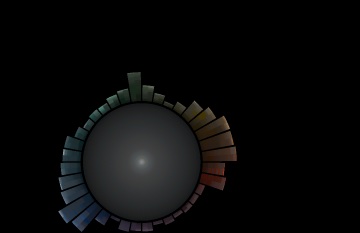
Chungking Express 1994
20% near black
11% blue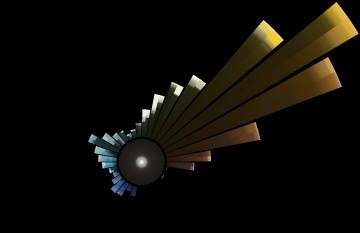
Ashes of Time 1994
19% near black
43% orange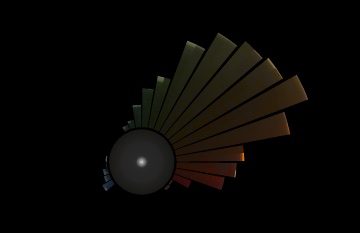
Fallen Angels 1995
54% near black
39% orange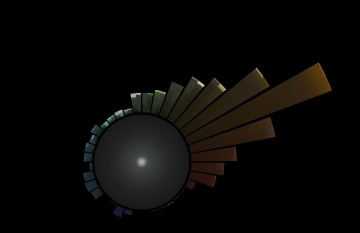
Happy Together 1997
18% near black
35% orange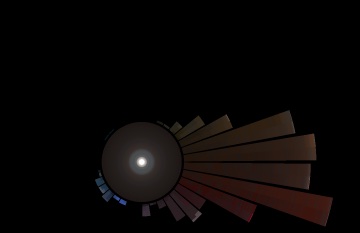
In the Mood for Love 2000
54% near black
50% orange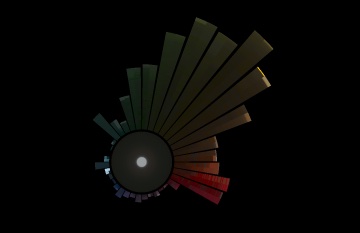
2046 2004
55% near black
28% yellow- 2007 and 2013 Darius Khondji, then Philippe Le Sourd
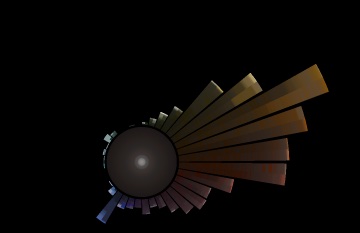
My Blueberry Nights 2007
33% near black
54% orange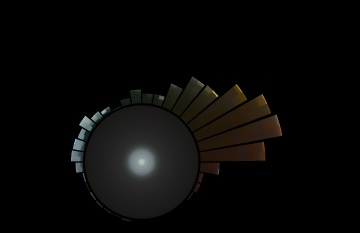
The Grandmaster 2013
59% near black
24% orange
Days of Being Wild is green and teal. In the Mood for Love is red and the dark orange next to it. Ashes of Time is orange and yellow. As Tears Go By and Chungking Express are gray and blue. By the count we used for Hirokazu Kore-eda’s films, two of Wong Kar-wai’s are 44% apart in color on average. Sets of 10 films picked at random from the same years are 40% apart, and 77% of those sets are at least as alike as his.
Where the red is, and the green
Red is the main color for 3% of the average Wong Kar-wai film, the same as for other films. Most of his is in one place. In the Mood for Love is 15% red, and seven of the other nine are under 2%. 2046 (2004), its loose sequel, is 5%. Count only strong reds, and those two rank 21st and 34th of the 1,557 live-action color films in Fade to Color.
Green is the main color for 11% of his films, against 5% (p = 0.04), and two films hold most of it: Days of Being Wild (42%) and 2046 (27%). With teal counted in, Days of Being Wild is 65% green, the sixth most of the 1,557. But it is a dim green: only 3% of the film is strongly colored.
As Tears Go By, his first, is the blue one, at 20% blue and 10% teal. It is among the six films from before 2000 with the most teal in our count of teal and orange. The first part of Happy Together is in black and white, about a fifth of its length.
Did it change after Christopher Doyle?
Christopher Doyle shot seven of the 10, from Days of Being Wild to 2046, though not always alone. Andrew Lau, who shot As Tears Go By, also shot the first of the two stories in Chungking Express. Mark Lee Ping-bing finished In the Mood for Love after Doyle left when the shoot ran over schedule, and 2046 credits three cinematographers. Darius Khondji shot My Blueberry Nights (2007) and Philippe Le Sourd The Grandmaster.
| Before (1) | Doyle (7) | Since (2) | Other films | |
|---|---|---|---|---|
| Near black | 42% | 40% | 46% | 28% |
| Color in the dark | 22% | 28% | 35% | 14% |
| Strong color | 5% | 17% | 19% | 13% |
Nothing we measured moves with him. The two films since 2046 are as dark as Doyle’s seven, with as much color in the dark and as much strong color. There are 120 ways to pick three films out of 10, and by none of these three counts is the real split an unusual one (p from 0.67 to 0.82).
Three films are too few to rule out a small change. But the film nearest in color to In the Mood for Love is not one of Doyle’s. It is My Blueberry Nights, shot in the United States seven years later: the two are 15% apart, the closest pair among the 10.
Every film’s color palette, with hex codes
These are the six main colors of each film, most common first, with their hex codes. They come from the seconds that are not near black, sorted into six groups of similar color. Each chip is the most typical color of its group. Under each title are the film’s shares of green, blue, orange and gray.
As Tears Go By 1988
3% green · 20% blue · 12% orange · 47% gray
- #1F2223
- #28393E
- #2A2116
- #513E36
- #56656B
- #112A1C
Days of Being Wild 1990
42% green · 1% blue · 1% orange · 30% gray
- #131E1C
- #1E2118
- #0E271F
- #273526
- #3F733C
- #2F8B77
Chungking Express 1994
5% green · 11% blue · 10% orange · 64% gray
- #202221
- #383835
- #283039
- #34261B
- #4F5857
- #481B05
Ashes of Time 1994
7% green · 3% blue · 43% orange · 10% gray
- #282112
- #503D17
- #BA9C2D
- #7F8B83
- #CCC9B2
- #35527A
Fallen Angels 1995
13% green · 1% blue · 39% orange · 20% gray
- #201B0D
- #2C2615
- #222222
- #33160B
- #55543B
- #E26402
Happy Together 1997
6% green · 2% blue · 35% orange · 41% gray
- #291E10
- #1F1F1F
- #2F3631
- #492F0C
- #849990
- #9A8237
In the Mood for Love 2000
0% green · 1% blue · 50% orange · 29% gray
- #241C19
- #2F2017
- #32140F
- #444346
- #CECDCD
- #344C97
2046 2004
27% green · 1% blue · 18% orange · 17% gray
- #221C11
- #191E19
- #1F2413
- #4D0F0E
- #7B685E
- #FECE02
My Blueberry Nights 2007
1% green · 2% blue · 54% orange · 23% gray
- #2A1E12
- #2B2425
- #4C341A
- #694B1E
- #82847F
- #354880
The Grandmaster 2013
4% green · 1% blue · 24% orange · 59% gray
- #1D1D1B
- #261C0D
- #2D2C29
- #768889
- #4F5857
- #5C4220
How we measured it
For each second of each film we took the frame’s main color and the average color of the whole frame, leaving out the first 4% and last 6% of the film (studio logos and credits). That is about 16 hours of film.
A second is near black when its main color is very dark (CIELAB lightness 8 or under). Of the rest, a second is gray when the main color has almost no saturation (chroma under 6) and strongly colored when it has a lot (chroma over 15). Red is hue 0° to 35°, green 110° to 170°, teal 170° to 220°. Near black is a share of all the seconds. Gray, strong color and the hues are shares of the seconds that are not near black.
Color in the dark is new to this post: a second whose main color is near black, while the average color of its frame is not gray (chroma over 6). A darker film has more room for it, so we also set each of his films beside other films as dark as it is. His have 8 points more (p < 0.001).
How dark the films are depends on where near black is drawn. At lightness 8, as in every post here, it is 41% against 28%. At 5 it is 20% against 15%, which is within chance (p = 0.23). At 12 it is 64% against 44% (p = 0.002). With no line at all, by the mean lightness of whole frames, his films are darker too: 25 against 31 on a scale of 100 (p = 0.006). The color in the dark is beyond chance wherever the line is.
The 10 films are Wong Kar-wai’s features. The Hand, the 56-minute cut of his part of the three-director film Eros (2004), is in Fade to Color but is not a feature, so it is left out. It is 52% near black, and only 20% of that dark has color in it. Blossoms Shanghai is a television series.
We measured the versions we have, and that matters more than usual here, because Wong Kar-wai has reworked his own films. Our Ashes of Time is the Redux version of 2008, which he re-edited and re-scored: 93 minutes, where the 1994 release ran 100. In 2021 came restorations of seven more, which he supervised: every film from As Tears Go By to 2046 but that one. They changed the color grading of some and the shape of Fallen Angels, from 1.85:1 to 2.39:1. Our copies of all seven run exactly as long as those restorations. Fallen Angels has the wide frame, and Chungking Express ends on the color credits the restoration added. So most of the colors here are probably his later choices, not what was in cinemas at the time. The color in the dark does not come from that round alone: the three films outside it have as much as the seven in it, 29% and 29%. The Grandmaster is the 130-minute cut released in China.
The comparison is every other live-action color film from 1988 to 2013 in Fade to Color: 723 of them. The p-values come from a permutation test on the difference between two averages. Against only the 489 dramas, or only the 39 other Hong Kong films and co-productions, the results are the same. Those 39 are near black for 17% of their length. The directors in the chart are the 23 with eight or more live-action color films in Fade to Color since 1930.
The limits: the main color is one color per second, so a frame that is mostly shadow with a red figure in it counts as near black. The average color mixes everything in the frame, so two colors can cancel toward gray. Our line between red and orange sits at 35°, and a pure red on a screen is at 40°, so the darkest reds of In the Mood for Love are split between the two. We tried many measures before settling on these, and the more one tries, the likelier a result by chance. The color in the dark is the one that held under every check. The comparison films lean toward well-known titles. All the versions are high definition, standard dynamic range.
| Film | Near black | Color in the dark | Strong color | Red |
|---|---|---|---|---|
| As Tears Go By 1988 | 42% | 22% | 5% | 2% |
| Days of Being Wild 1990 | 59% | 42% | 3% | 0% |
| Chungking Express 1994 | 20% | 16% | 6% | 1% |
| Ashes of Time 1994 | 19% | 17% | 52% | 0% |
| Fallen Angels 1995 | 54% | 45% | 16% | 2% |
| Happy Together 1997 | 18% | 13% | 15% | 1% |
| In the Mood for Love 2000 | 54% | 21% | 16% | 15% |
| 2046 2004 | 55% | 46% | 14% | 5% |
| My Blueberry Nights 2007 | 33% | 30% | 30% | 7% |
| The Grandmaster 2013 | 59% | 41% | 7% | 0% |
See any film’s colors
Fade to Color shows thousands of films as their colors, from the first frame to the credits, including all 10 of these. Scrub through one scene by scene, draw it as a spiral or ripples, or guess films from their colors alone.