Movies didn’t add orange. They added teal.
For years the complaint has been that every big film is graded the same two colors: teal in the shadows, orange on the skin. We measured 1,409 live-action films from 1970 to 2025, second by second, to see what changed. Only one of the two colors did.
- 9% of films from 1970 to 1999 have noticeable teal
- 28% of films from 2000 to 2025 do
- 24–39% of a film’s running time is orange, in every five-year span since 1970
One film in ten, then more than one in four
We call a film’s teal noticeable when teal is the main color on screen for more than 5% of its running time. From 1970 to 1999, 9% of live-action films pass that mark. From 2000 to 2025, 28% do.
The climb starts in 2000–2004 (20%) and peaks in 2005–2009, when 34% of films have noticeable teal. It dips to 22% in the early 2010s and is back to 32% for 2020–2025.
The timing matches the arrival of digital color grading. O Brother, Where Art Thou? (2000) is usually cited as the first Hollywood feature graded entirely on a computer, and within a decade that was the normal way to finish a film. Colors alone can’t prove that the software caused the teal. What they show is that the two arrived in the same five years. O Brother itself went the other way: it is 72% orange and 2% teal.
Orange was always there
Orange and amber are the main color for 24% to 39% of the average film’s running time in every five-year span we measured. The warmest years are 1990–1994, not the 2000s, and the share has been lower since 2015 than at any time before it.
Teal more than doubled, from between 1% and 2% of the running time before 2000 to between 3% and 5% since. It is still a small color. In films from 2020–2025 there are about 6 orange seconds for every teal one. The look people noticed is a thin layer of teal laid over a warmth that was already there.
The films with the most of both
These are the films since 2000 that spend the most time in both colors, ranked by whichever of the two they have less of. Each strip is a whole film, its first frame on the left and its credits on the right, in the average color of each moment. The band underneath marks the seconds we counted as teal or orange.
Cloverfield 2008
teal 26% · orange 41%
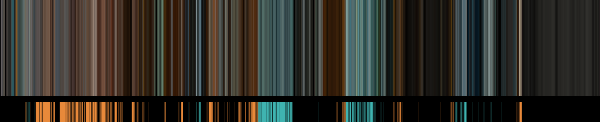
Infernal Affairs III 2003
teal 31% · orange 20%
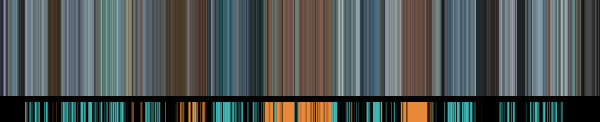
John Wick: Chapter 2 2017
teal 23% · orange 18%
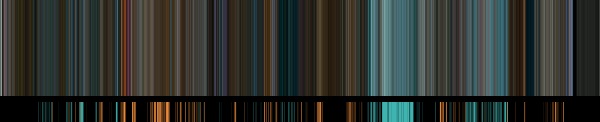
Frankenstein 2025
teal 18% · orange 18%
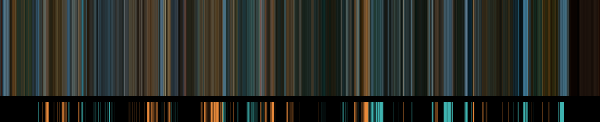
Mickey 17 2025
teal 26% · orange 17%
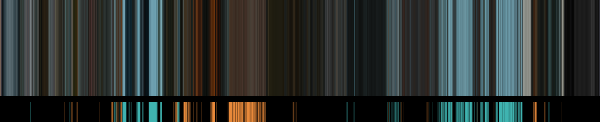
Only Lovers Left Alive 2013
teal 19% · orange 17%
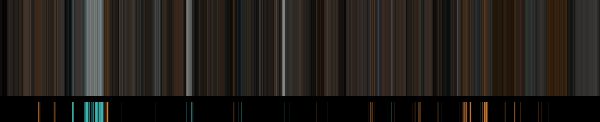
The Lord of the Rings: The Fellowship of the Ring 2001
teal 16% · orange 24%
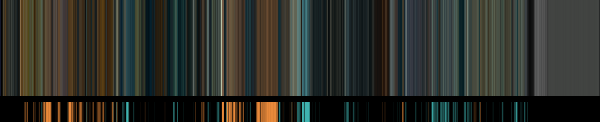
Thunderbolts* 2025
teal 16% · orange 21%
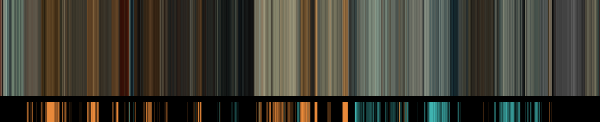
Teal before 2000
Teal was not invented in 2000. These six films from before then would rank among the most teal of any year. Two of them, The Abyss and The Terminator, are James Cameron’s. What changed after 2000 is how many films joined them.
On the Silver Globe 1988
teal 51% · orange 0%
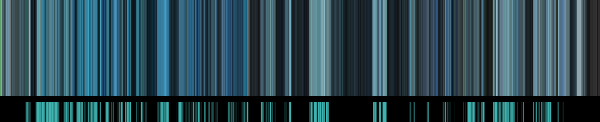
The Abyss 1989
teal 42% · orange 1%
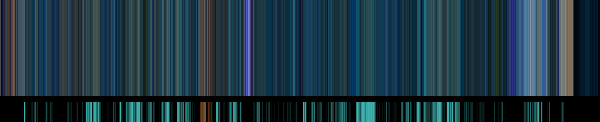
Blade Runner 1982
teal 33% · orange 14%
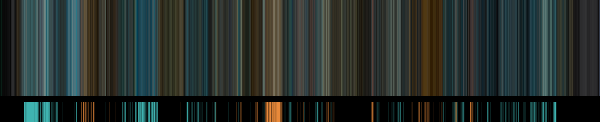
As Tears Go By 1988
teal 25% · orange 12%
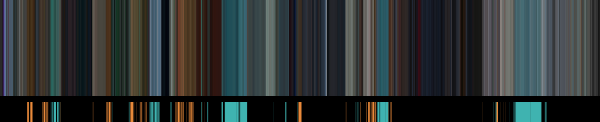
Thief 1981
teal 24% · orange 4%
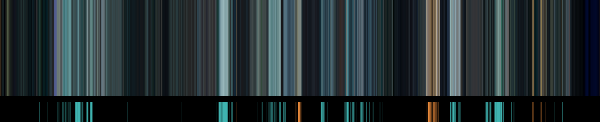
The Terminator 1984
teal 22% · orange 12%
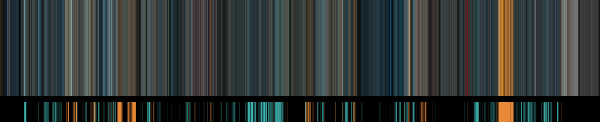
A caution about this list: we measure older films from the versions available today, and some have been regraded since their first release. A restoration can add teal that the original prints did not have.
What this count misses
Mad Max: Fury Road (2015) is often held up as the teal-and-orange film. By our count it is 77% orange and 2% teal.
Mad Max: Fury Road 2015
teal 2% · orange 77%
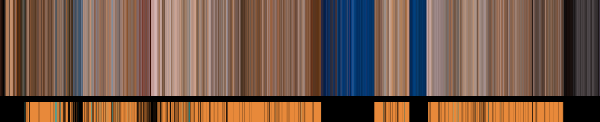
The reason is the method. We take one main color for each second, so when teal and orange share a frame, only the larger of the two is counted. A film that puts both colors in every shot scores as one color. That makes the figures here a floor for the look, not a full count of it.
American films changed the most
Among American films, the share with noticeable teal went from 7% in 1975–1999 to 29% in 2000–2025. For films from everywhere else it went from 12% to 25%. American films started with less teal and ended with more.
How we measured it
We took every color film in Fade to Color: 1,818 of them, 1,549 live action. Animation (269 films) is left out of every figure above, and the figures by year use the 1,409 live-action films from 1970 to 2025. For each second of each film we took the frame’s main color, leaving out the first 4% and last 6% of the film (studio logos and credits) and anything close to black.
Teal is a hue between green-blue and sky blue (CIELAB hue 180° to 250°). Orange is a hue between red-orange and yellow (35° to 85°). Both need at least a little saturation (chroma over 6). A film has noticeable teal if teal is its main color for more than 5% of the seconds measured.
The limits: this counts the main color of each second, not the split inside a frame, so it undercounts the look. Older films are measured from today’s restorations, and some have been regraded. The films are the ones in Fade to Color, which lean toward well-known titles. And the five-year groups hold between 84 and 181 films each, so a single span can move a few points by chance.
| Years | Films | Noticeable teal | Teal | Orange |
|---|---|---|---|---|
| 1970–1974 | 89 | 11% | 2.0% | 29.4% |
| 1975–1979 | 84 | 4% | 1.1% | 33.4% |
| 1980–1984 | 87 | 8% | 2.2% | 33.2% |
| 1985–1989 | 105 | 10% | 2.4% | 29.7% |
| 1990–1994 | 131 | 11% | 1.7% | 38.8% |
| 1995–1999 | 143 | 11% | 1.6% | 34.4% |
| 2000–2004 | 153 | 20% | 3.1% | 32.6% |
| 2005–2009 | 143 | 34% | 4.6% | 31.5% |
| 2010–2014 | 148 | 22% | 3.5% | 28.4% |
| 2015–2019 | 145 | 29% | 4.6% | 24.1% |
| 2020–2025 | 181 | 32% | 4.6% | 27.2% |
See any film’s colors
Fade to Color shows thousands of films as their colors, from the first frame to the credits. Scrub through one scene by scene, draw it as a spiral or ripples, or guess films from their colors alone.