Christopher Nolan has two palettes. They split in 2014.
Christopher Nolan’s films are usually described in cold colors: steel blue, gray, a lot of black. We measured every second of all 13, from Following (1998) to The Odyssey (2026), to see whether they are getting colder. They are not. His 12 color films fall into two palettes, and the line between them is 2014, the year his cinematographer changed. Blue was the main color for 7% of the running time before and 2% since. Green went from 1% to 19%.
- 7% blue: his seven films shot by Wally Pfister, 2000 to 2012
- 2% blue: the five shot by Hoyte van Hoytema, 2014 to 2026
- 19% green in those five, up from 1%
Two palettes, one for each cinematographer
Wally Pfister shot every Nolan film from Memento (2000) to The Dark Knight Rises (2012). Hoyte van Hoytema has shot every one since Interstellar (2014). In Pfister’s seven, what is not gray is mostly orange and brown (28% of the running time) and blue (7%). Yellow, green and teal together come to 3%. In van Hoytema’s five those three come to 40%, while orange is down to 13% and blue to 2%.
Here are all 13 films, each as its own flower and all at one scale. Pfister’s seven reach to the right, where orange is, and down to the left, where blue is. The five since reach upward, toward green.
- 1998 Nolan
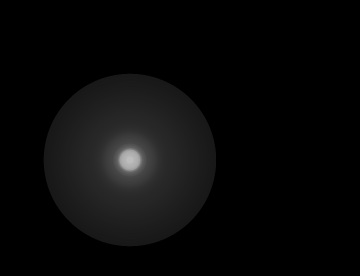
Following 1998
black and white
- 2000 to 2012 Wally Pfister
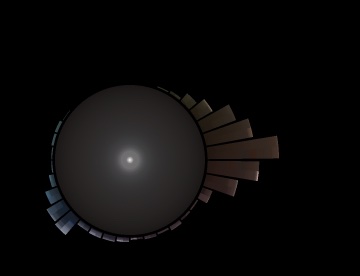
Memento 2000
4% blue · 0% green
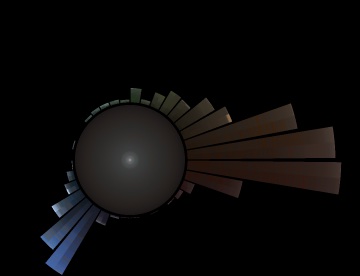
Insomnia 2002
11% blue · 2% green
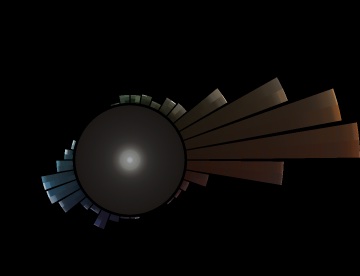
Batman Begins 2005
6% blue · 1% green
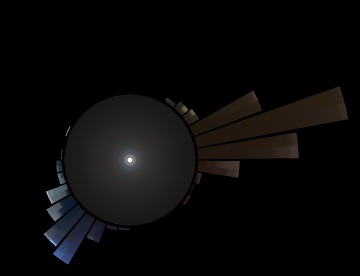
The Prestige 2006
9% blue · 0% green
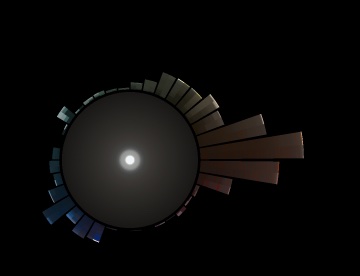
The Dark Knight 2008
6% blue · 3% green
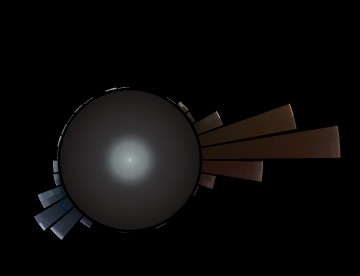
Inception 2010
7% blue · 0% green
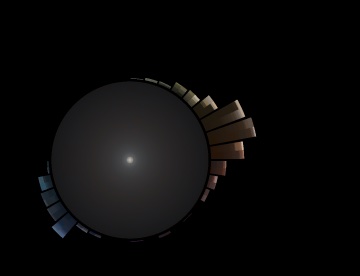
The Dark Knight Rises 2012
4% blue · 0% green
- 2014 to 2026 Hoyte van Hoytema
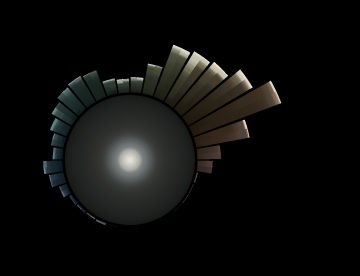
Interstellar 2014
3% blue · 9% green
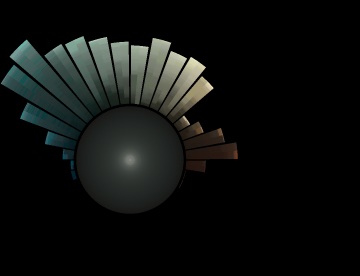
Dunkirk 2017
1% blue · 23% green
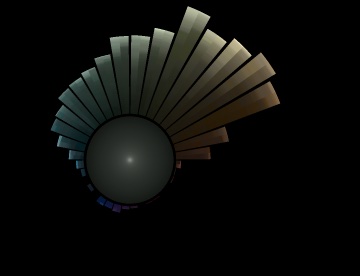
Tenet 2020
1% blue · 28% green
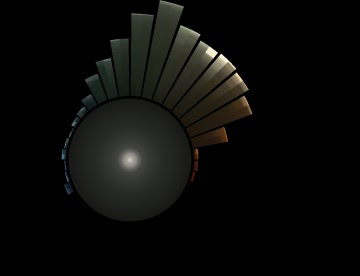
Oppenheimer 2023
1% blue · 26% green
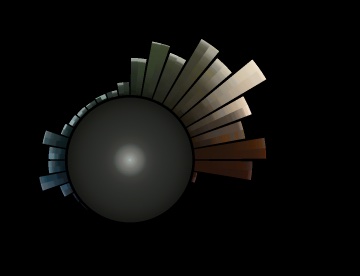
The Odyssey 2026
4% blue · 9% green
The two groups do not overlap. The greenest of the seven is The Dark Knight, at 3% green. The least green of the five is Interstellar, at 9%. There are 792 ways to divide 12 films into a seven and a five, and the one Nolan’s career made has the widest gap in green of them all. The same is true of yellow and of teal.
As far apart as two films picked at random
One number can stand for the whole difference. We sorted every measured second of a film into eight groups, gray and seven colors around the wheel, and counted how much of the running time would have to change groups for one film’s mix to match another’s. By that count two of Pfister’s films are 22% apart on average, and two of van Hoytema’s are 25% apart. Take one film from each group and they are 40% apart.
For scale, we did the same with the 838 other live-action color films of 1998 to 2026 in Fade to Color. Two of those, picked at random, are 39% apart. So in color, a Nolan film from before 2014 has no more in common with one from after than two unrelated films have. Inside each group it is the opposite. All 12 have their nearest neighbor in their own group, and of 10,000 random sets of seven films, 27 were as alike as Pfister’s seven. Van Hoytema’s group is less certain, with only five films (p = 0.04).
The colors alone would draw the same line. There are 2,035 ways to divide 12 films into two groups of two or more, and the one that leaves the films inside each group most alike is this one: Pfister’s seven on one side, van Hoytema’s five on the other. The runner-up moves Interstellar and The Odyssey, the two least green of the five, over to the first group.
Gray and dark, through 2012
The usual description is half right about the first group. From 2000 to 2012 the average Nolan film is gray for 61% of its running time. The 380 other films of those years average 40% (p = 0.005). It spends 43% of its length near black, against 29% (p = 0.02). The Dark Knight Rises is the extreme: 83% gray, and near black for 66% of its length.
It is wrong about the blue. Blue is the main color for 7% of those seven films and for 6% of the films around them, which is no difference at all (p = 0.79). The bluest is Insomnia (2002), set in an Alaskan summer where the sun never sets, at 11%. Next is The Prestige, at 9%. What set these seven apart was how little color they had of any kind, not which color it was.
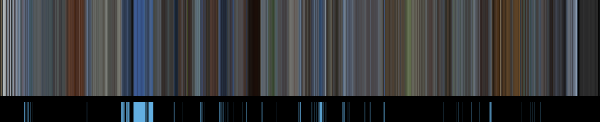
Here is Insomnia whole, first frame on the left and credits on the right, in the average color of each moment. The band underneath marks the seconds we counted as blue.
Insomnia 2002
11% blue
Since 2014: green, and no grayer than other films
The five films since Interstellar are gray for 45% of their running time, and the 369 other films of their years for 45%. They are no darker either: 27% near black, against 29%. What sets them apart is green, 19% against 7% (p = 0.01), and teal, 8% against 2% (p = 0.004).
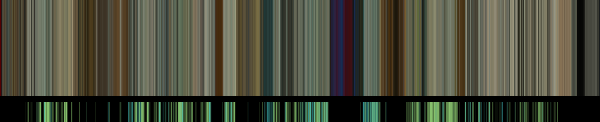
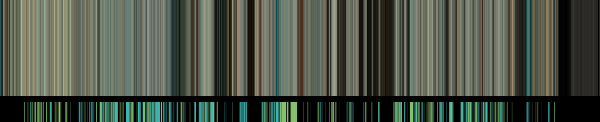
It is not a bright green. About two thirds of it is olive, on the yellow side of green, and it arrives with khaki and sand: yellow went from 2% to 12%. Tenet (2020) is the greenest Nolan film, at 28%, then Oppenheimer (2023) at 26% and Dunkirk (2017) at 23%. Dunkirk, set on a beach, at sea and in the air above them, is also 23% teal, more than any other film of his. Here are Tenet and Dunkirk, with the seconds we counted as green and teal marked underneath.
Tenet 2020
28% green · 9% teal
Dunkirk 2017
23% green · 23% teal
The Odyssey, the newest, sits with the group: 9% green, 13% yellow, 4% blue. The film nearest to it in color is Interstellar, 8% apart. In one way it goes back: 52% of it is near black, against 20% for the other four. It is his darkest film since The Dark Knight Rises.
So are they getting colder?
No. Blue is the color that fell. Teal rose, from under 1% to 8%, more than half of that in Dunkirk, so the two cold colors together were 7% of the running time before 2014 and are 10% since. That difference is well within chance (p = 0.40). What grew was olive green and khaki, and those lean toward yellow, the warm side of the wheel.
Three films with black and white
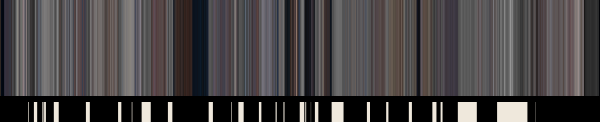
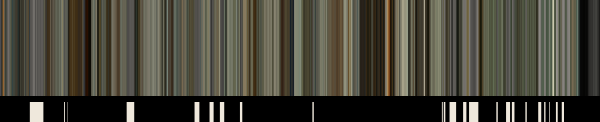
Following (1998), which Nolan shot himself on 16mm film, is black and white throughout, so it is in neither group. Memento alternates black-and-white scenes with color ones. Oppenheimer does the same for the scenes that follow Lewis Strauss, which were shot on the first black-and-white film made for IMAX cameras. By our count those scenes are 28% of what we measured of Memento and 17% of Oppenheimer. The bands below mark them.
Memento 2000
28% black and white
Oppenheimer 2023
17% black and white
Those scenes are part of each film’s gray in the figures above. Leave them out and the color scenes of Memento are 67% gray, still far above other films of its years, and those of Oppenheimer are 40%.
What changed in 2014
The cinematographer did, and the palette changed in the same film. The colors can’t say that one caused the other. Van Hoytema’s work for other directors is not green: his four other films in Fade to Color, from Let the Right One In (2008) to Spectre (2015), average 2% green, and Her (2013) is 86% orange. Nor does it look like a change in digital grading, because films on both sides of the line were finished without any. The Dark Knight Rises was made without a digital intermediate, and the color of The Odyssey was set the analog way, with filters on a light table.
Nolan may leave more of the color to others than most directors do. He is red-green color-blind. Asked in 2017 about the Joker’s purple, he said he left it to the costume designer, Lindy Hemming: “I can barely see shades of purple” (BAFTA, A Life in Pictures).
What the numbers do show is a director whose films look alike for seven films, then alike in a different way for five, with nothing in between.
Every film’s color palette, with hex codes
These are the six main colors of each film, most common first, with their hex codes. They come from the same seconds as everything above, sorted into six groups of similar color. Each chip is the most typical color of its group. Under each title are the film’s shares of green, blue, orange and gray.
Following 1998
0% green · 0% blue · 0% orange · 100% gray
- #1C1C1C
- #272727
- #3C3C3C
- #555555
- #ABABAB
- #777777
Memento 2000
0% green · 4% blue · 16% orange · 76% gray
- #201E1E
- #2E2C2B
- #2C221C
- #3E3E41
- #21242B
- #6D6D6D
Insomnia 2002
2% green · 11% blue · 41% orange · 41% gray
- #271B15
- #352F28
- #212227
- #42464F
- #3D5384
- #7F94AF
Batman Begins 2005
1% green · 6% blue · 48% orange · 40% gray
- #211D1A
- #2D1E15
- #1E2A34
- #454037
- #613F27
- #6F797F
The Prestige 2006
0% green · 9% blue · 31% orange · 58% gray
- #251B13
- #1C1E20
- #322F2E
- #515962
- #2A3C5D
- #B1CBE0
The Dark Knight 2008
3% green · 6% blue · 22% orange · 62% gray
- #21201D
- #38352F
- #2C1E18
- #132130
- #989A97
- #AB612D
Inception 2010
0% green · 7% blue · 27% orange · 65% gray
- #211D1B
- #2D2C2E
- #2E1C10
- #4F5154
- #788384
- #DDBC97
The Dark Knight Rises 2012
0% green · 4% blue · 10% orange · 83% gray
- #1C1E21
- #241E19
- #2E2B2B
- #3C4047
- #554330
- #998A75
Interstellar 2014
9% green · 3% blue · 16% orange · 57% gray
- #1F2423
- #2E281E
- #363B37
- #656C6A
- #4D4431
- #BFBEAF
Dunkirk 2017
23% green · 1% blue · 7% orange · 39% gray
- #21221E
- #293B39
- #596C63
- #829182
- #4B4E43
- #B5B296
Tenet 2020
28% green · 1% blue · 16% orange · 26% gray
- #1F2722
- #271F12
- #3B3F33
- #6B6A57
- #A2A386
- #181436
Oppenheimer 2023
26% green · 1% blue · 9% orange · 51% gray
- #1D1F1A
- #2A2E26
- #45473D
- #3D2A15
- #817C69
- #D6C7A7
The Odyssey 2026
9% green · 4% blue · 19% orange · 52% gray
- #242622
- #403F34
- #79786F
- #2A170D
- #C5BAA6
- #4B260A
How we measured it
For each second of each film we took the frame’s main color, leaving out the first 4% and last 6% of the film (studio logos and credits) and anything close to black. That is about 27 hours of film.
A second is gray when its main color has almost no saturation (CIELAB chroma under 6). Otherwise it is one of seven colors by hue: red (0° to 35°), orange (35° to 85°), yellow (85° to 110°), green (110° to 170°), teal (170° to 220°), blue (220° to 290°), or purple and pink (290° to 360°). Teal here is narrower than in our post on teal and orange, where it ran to 250°, so that no hue is counted twice. Near black is a share of all the seconds. The rest are shares of the seconds that are not near black.
A second is black and white when the frame’s average color and its main color both sit almost exactly on gray (within 1.3 and 1.6 CIELAB units of it), and most of the nine seconds around it do too. In Following and Memento that gray is neutral. In the copy of Oppenheimer we measured, the black-and-white scenes carry a faint warm tone, so there it is that tone.
The comparison is every other live-action color film from 1998 to 2026 in Fade to Color: 838 of them, 380 from 2000 to 2012 and 369 from 2014 to 2026. The p-values come from a permutation test on the difference between two averages. Between Nolan’s own two groups, seven films and five, we counted every possible split instead of sampling.
The limits: we take one main color per second, so a frame that is half sand and half sea counts as whichever is larger. The comparison films lean toward well-known titles. And we measured the versions we have, all in high definition and standard dynamic range. That matters more than usual here. Several of these films have been remastered since their first release, and a new transfer can shift the color of a whole film.
| Film | Gray | Near black | Blue | Green |
|---|---|---|---|---|
| Following 1998 | 100% | 52% | 0% | 0% |
| Memento 2000 | 76% | 18% | 4% | 0% |
| Insomnia 2002 | 41% | 25% | 11% | 2% |
| Batman Begins 2005 | 40% | 38% | 6% | 1% |
| The Prestige 2006 | 58% | 57% | 9% | 0% |
| The Dark Knight 2008 | 62% | 54% | 6% | 3% |
| Inception 2010 | 65% | 47% | 7% | 0% |
| The Dark Knight Rises 2012 | 83% | 66% | 4% | 0% |
| Interstellar 2014 | 57% | 10% | 3% | 9% |
| Dunkirk 2017 | 39% | 27% | 1% | 23% |
| Tenet 2020 | 26% | 23% | 1% | 28% |
| Oppenheimer 2023 | 51% | 21% | 1% | 26% |
| The Odyssey 2026 | 52% | 52% | 4% | 9% |
See any film’s colors
Fade to Color shows thousands of films as their colors, from the first frame to the credits, including all 13 of these. Scrub through one scene by scene, draw it as a spiral or ripples, or guess films from their colors alone.