Studio Ghibli is twice as green as other animation.
We measured every second of 24 Studio Ghibli films, from Nausicaä of the Valley of the Wind (1984) to The Boy and the Heron (2023). Green is the main color on screen for 14% of the average one. In 244 other animated films it is 6%. Purple and pink fill 14% of those films and 2% of Ghibli’s.
- 14% green: the average Studio Ghibli film
- 6% green: 244 other animated films
- 2% purple or pink, against 14% in other animation
More than twice as green
A second counts as green when the main color in the frame is green, anywhere from yellow-green to sea green. By that count the average Ghibli film is 14% green. The comparison is every other animated film in Fade to Color, 244 of them, from Snow White and the Seven Dwarfs to Spider-Man: Across the Spider-Verse. They average 6%.
The gap is very unlikely to be chance (p < 0.001), and it is not a matter of setting Ghibli against Hollywood. 68 of the comparison films are in Japanese, Akira and Your Name among them. They average 8% green, and Ghibli’s lead over them holds too (p = 0.003). Live action is no greener: 6% across 1,549 films.
19 of the 24 Ghibli films are greener than the average for other animation. 6 of them are green for more than a fifth of their running time. Of the 244 others, 7 are.
The greenest animated film we have measured is not one of Ghibli’s. 100 Meters (2025) is 44% green and Rio 2 (2014) is 43%. What sets the studio apart is how often it happens: 16 of its 24 films are more than a tenth green, against 49 of the other 244.
Green is not the biggest color in a Ghibli film either. Orange is larger (17%) and blue is level with green (14%). But orange is lower than in other animation (24%) and blue is about the same (15%). Green is the one that doubles. So do the yellows beside it, the straw, khaki and cream that include the tallest petals in Ghibli’s flower: 11% against 5%.
The five greenest
Three of the five are Hayao Miyazaki’s. When Marnie Was There was directed by Hiromasa Yonebayashi and Whisper of the Heart by Yoshifumi Kondō. Each strip is a whole film, first frame on the left and credits on the right, in the average color of each moment. The band underneath marks the seconds we counted as green.
The Boy and the Heron 2023
33% green
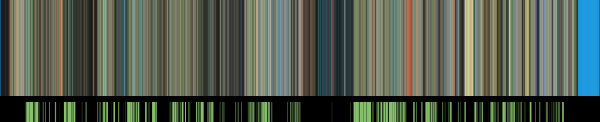
When Marnie Was There 2014
32% green
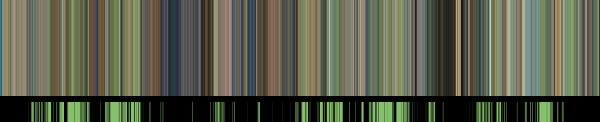
Whisper of the Heart 1995
26% green
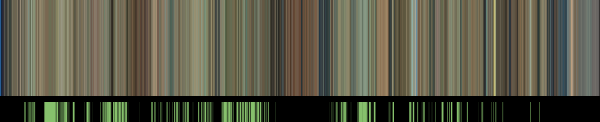
My Neighbor Totoro 1988
23% green
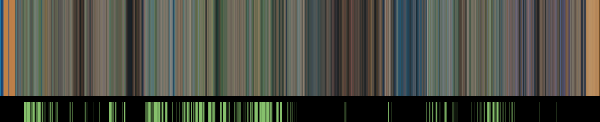
Ponyo 2008
23% green
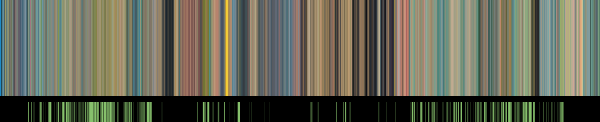
The green is not one director’s habit. Miyazaki’s 11 films average 13% green and Isao Takahata’s 5 average 8%. The 8 films by the studio’s 5 other directors average 17%. All three figures are above the 6% for other animation.
What Ghibli leaves out
The other half of the palette is what is missing. Purple and pink, everything from violet to rose, are the main color for 14% of the average animated film outside Ghibli. In Ghibli’s films they are 2% (p < 0.001). No Ghibli film is more than 10% purple and pink. 115 of the 244 other films are.
Ghibli also spends less time near black: 7% of the running time, against 16% for other animation. Not all of that is Ghibli’s own. Other Japanese animation is at 10%, and with 24 films we can’t tell 7% from 10% (p = 0.14).
None of this makes Ghibli more colorful than other animation. By one measure it is less: 36% of the average Ghibli film has almost no saturation, against 25% for other animation as a whole. Other Japanese animation is at 36%. The color Ghibli has is spent differently.
All 24 films
Here is each film as its own flower, in release order and at one scale. Most lean toward the top and upper right, where green and yellow are. Blue is on the left and orange on the right. Almost nothing grows downward, where purple and pink would be.
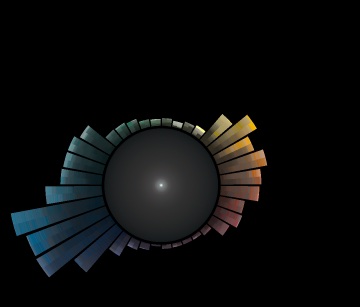
Nausicaä 1984
2% green
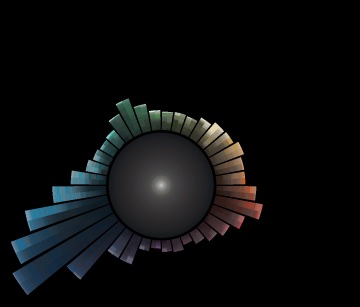
Castle in the Sky 1986
6% green
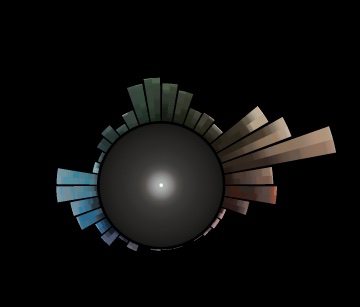
Grave of the Fireflies 1988
10% green
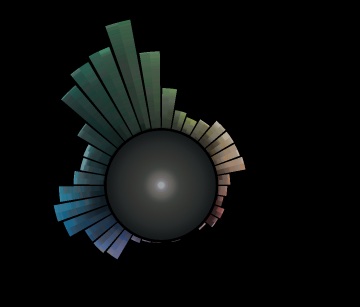
My Neighbor Totoro 1988
23% green
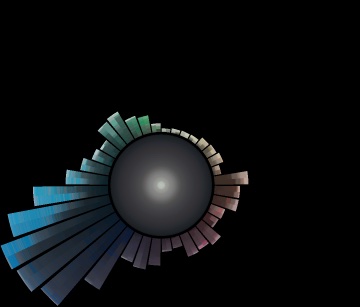
Kiki’s Delivery Service 1989
2% green
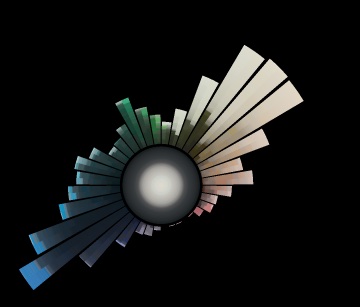
Only Yesterday 1991
11% green
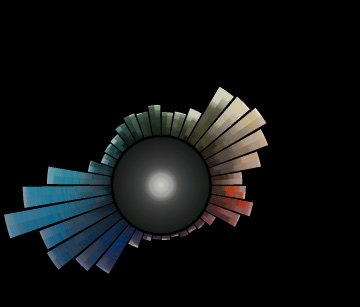
Porco Rosso 1992
7% green
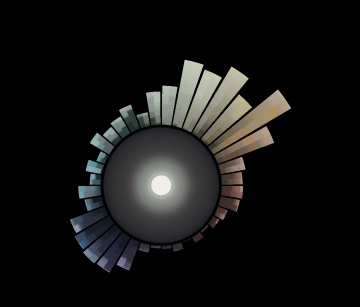
Ocean Waves 1993
14% green
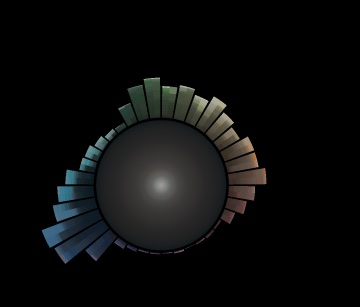
Pom Poko 1994
11% green
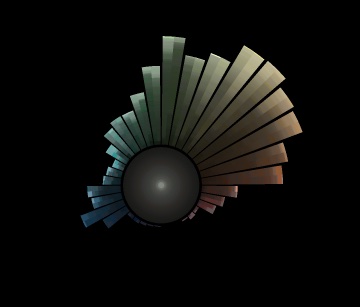
Whisper of the Heart 1995
26% green
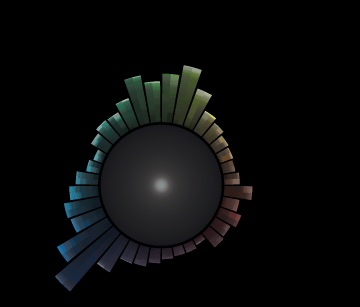
Princess Mononoke 1997
15% green
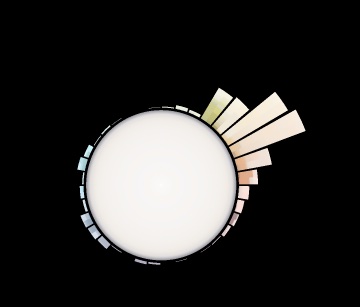
My Neighbors the Yamadas 1999
0% green
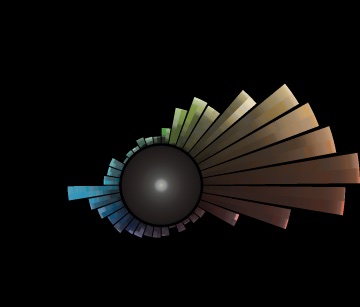
Spirited Away 2001
5% green
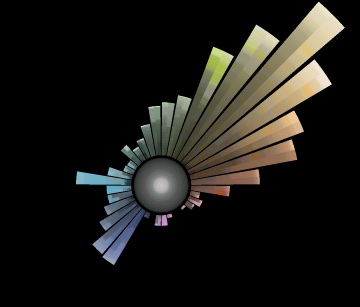
The Cat Returns 2002
15% green
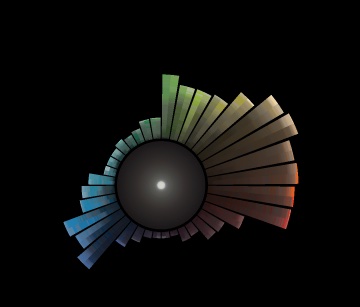
Howl’s Moving Castle 2004
11% green
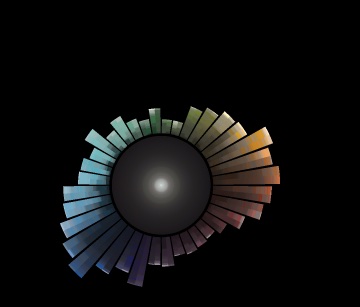
Tales from Earthsea 2006
5% green
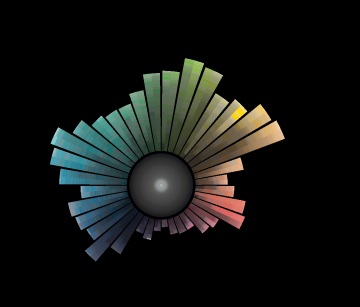
Ponyo 2008
23% green
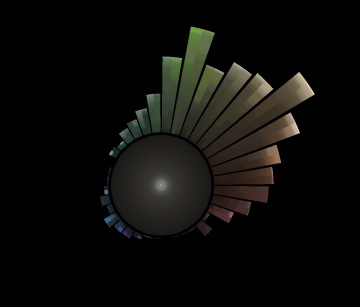
Arrietty 2010
20% green
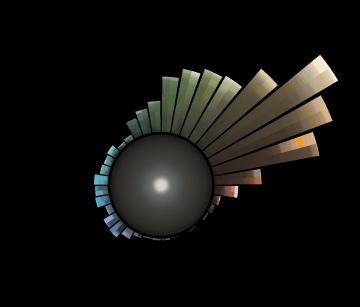
From Up on Poppy Hill 2011
14% green
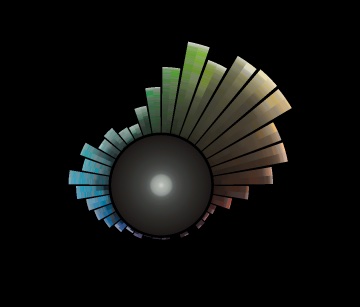
The Wind Rises 2013
19% green
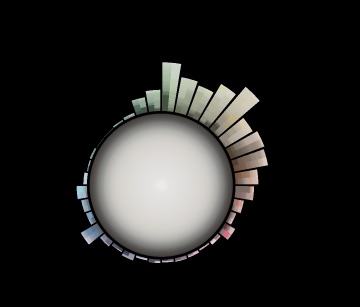
Princess Kaguya 2013
9% green
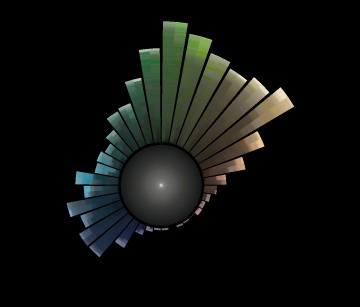
When Marnie Was There 2014
32% green
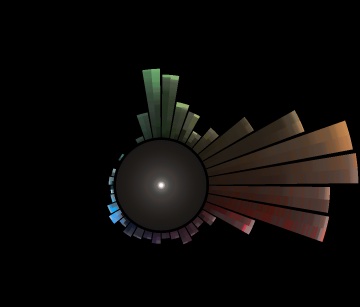
Earwig and the Witch 2020
11% green
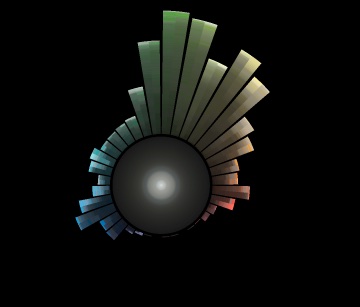
The Boy and the Heron 2023
33% green
Miyazaki started blue
Miyazaki’s first five films here are not green. They are blue. From Nausicaä (1984) to Porco Rosso (1992) they average 30% blue and 8% green. Kiki’s Delivery Service is 42% blue, the most of any Ghibli film. The exception is My Neighbor Totoro, at 23% green.
His six films since, from Princess Mononoke (1997) to The Boy and the Heron, average 11% blue and 18% green. None of them is more than 17% blue.
Flight runs through four of the first five: a glider in Nausicaä, a flying castle, a witch’s flying delivery service, a fighter pilot. That alone does not explain the blue. Most of it is dark, nearer navy than sky (21 of the 30 points). And The Wind Rises (2013), about an aircraft designer, is 6% blue and 19% green.
Takahata’s paper
Two films in the set are close to one color, and the color is paper. My Neighbors the Yamadas (1999) is light and nearly colorless for 87% of its running time. The Tale of the Princess Kaguya (2013) is for 50%. Both were directed by Isao Takahata. Of the 2,166 films we have measured, of any kind, they are the two lightest.
My Neighbors the Yamadas 1999
87% paper
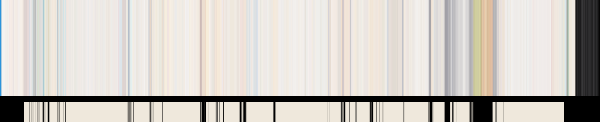
The Tale of the Princess Kaguya 2013
50% paper
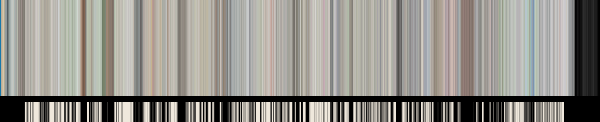
Yamadas is based on a four-panel comic strip, and Takahata wanted it to look like watercolor pictures, not painted cels. Kaguya has watercolor backgrounds by Kazuo Oga. In our numbers that shows as blank page: the largest area of the frame is off-white for most of Yamadas and half of Kaguya. Takahata’s Only Yesterday (1991) is 22% paper, which ranks eighth of the 2,166.
Spirited Away is the orange one
Studio Ghibli has won the Academy Award for Best Animated Feature twice, and the two winners sit at opposite ends of this count. The Boy and the Heron is the greenest of the 24, at 33%. Spirited Away (2001) is 5% green and 50% orange, the most orange film in the set.
Spirited Away 2001
50% orange
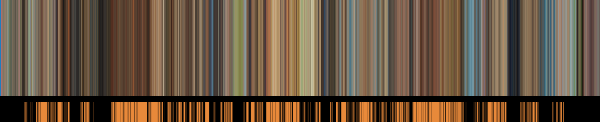
No other Miyazaki film is more than 28% orange. The only film that comes close is Earwig and the Witch (2020), the studio’s first fully 3D computer-animated film, at 47%.
Every film’s color palette, with hex codes
These are the six main colors of each film, most common first, with their hex codes. They come from the same seconds as everything above, sorted into six groups of similar color. Each chip is the most typical color of its group. Under each title are the film’s shares of green, blue, orange and gray.
Nausicaä of the Valley of the Wind 1984
2% green · 28% blue · 11% orange · 44% gray
- #24282B
- #2C5267
- #5F483C
- #A1865B
- #647F7F
- #C48B1F
Castle in the Sky 1986
6% green · 32% blue · 8% orange · 37% gray
- #292526
- #1E2B38
- #47473E
- #446E82
- #A29983
- #8A4C2E
Grave of the Fireflies 1988
10% green · 9% blue · 23% orange · 51% gray
- #262320
- #3D3D36
- #7A6757
- #55798C
- #AA998A
- #96432D
My Neighbor Totoro 1988
23% green · 14% blue · 4% orange · 40% gray
- #2F3A36
- #1D2425
- #395542
- #2A5974
- #625A54
- #918871
Kiki’s Delivery Service 1989
2% green · 42% blue · 4% orange · 35% gray
- #202731
- #3C3C41
- #3581A3
- #6A6363
- #9CA09B
- #427360
Only Yesterday 1991
11% green · 26% blue · 12% orange · 20% gray
- #222A32
- #CDC9BA
- #3A4138
- #96867A
- #5585B2
- #257A59
Porco Rosso 1992
7% green · 32% blue · 12% orange · 31% gray
- #292926
- #36708A
- #5E584D
- #253A4F
- #AEA490
- #A0452C
Ocean Waves 1993
14% green · 11% blue · 11% orange · 45% gray
- #3B3A3A
- #26282F
- #B8BAA8
- #8C948F
- #676461
- #9C896C
Pom Poko 1994
11% green · 16% blue · 8% orange · 57% gray
- #1F2326
- #343430
- #544F44
- #42677E
- #8C8F81
- #AF6F3F
Whisper of the Heart 1995
26% green · 6% blue · 21% orange · 20% gray
- #22221F
- #374135
- #3C3125
- #706852
- #A19B7A
- #6D8C80
Princess Mononoke 1997
15% green · 17% blue · 4% orange · 50% gray
- #202226
- #3E3533
- #333F2E
- #18556D
- #898878
- #506E3E
My Neighbors the Yamadas 1999
0% green · 2% blue · 13% orange · 76% gray
- #F5F2EF
- #F1E6D8
- #D4DBDC
- #ABAAB0
- #E2B594
- #CAC991
Spirited Away 2001
5% green · 7% blue · 50% orange · 21% gray
- #2C2523
- #4C3A2D
- #876847
- #B5A784
- #3F7085
- #6C8246
The Cat Returns 2002
15% green · 11% blue · 23% orange · 10% gray
- #504F44
- #8F8A6F
- #D6C8A7
- #6A7992
- #947252
- #B9AF59
Howl’s Moving Castle 2004
11% green · 14% blue · 28% orange · 26% gray
- #2C2524
- #51493A
- #3C7490
- #908666
- #748E45
- #BE5630
Tales from Earthsea 2006
5% green · 19% blue · 17% orange · 33% gray
- #221F23
- #433A33
- #7B9EA5
- #746652
- #314B66
- #C28949
Ponyo 2008
23% green · 17% blue · 13% orange · 14% gray
- #37393C
- #596248
- #52868A
- #B49E76
- #BE6F63
- #99AC53
Arrietty 2010
20% green · 2% blue · 22% orange · 34% gray
- #23201D
- #383025
- #4D4C38
- #948771
- #5A6F3A
- #304B68
From Up on Poppy Hill 2011
14% green · 3% blue · 28% orange · 35% gray
- #322D28
- #4F4D42
- #757253
- #C3B79D
- #6193AA
- #C6873B
The Wind Rises 2013
19% green · 6% blue · 17% orange · 34% gray
- #2A2622
- #424136
- #6D6D52
- #58889B
- #B4AC8E
- #64913A
The Tale of the Princess Kaguya 2013
9% green · 3% blue · 8% orange · 70% gray
- #D7D5D1
- #A09F9C
- #4F4B47
- #787874
- #BABAA9
- #9C7761
When Marnie Was There 2014
32% green · 13% blue · 9% orange · 22% gray
- #32332D
- #465338
- #212F3C
- #5A6D71
- #B3A281
- #547B37
Earwig and the Witch 2020
11% green · 2% blue · 47% orange · 28% gray
- #251F1A
- #493F34
- #431E16
- #8E6042
- #5B8B5C
- #7599C1
The Boy and the Heron 2023
33% green · 6% blue · 9% orange · 32% gray
- #2A2B28
- #454E3B
- #948E7C
- #949F64
- #5891A8
- #C26433
How we measured it
For each second of each film we took the frame’s main color, leaving out the first 4% and last 6% of the film (studio logos and credits) and anything close to black. That is about 38 hours of film.
A second is green when its hue is between yellow-green and sea green (CIELAB hue 110° to 170°), yellow from there down to 85°, orange between yellow and red-orange (85° to 35°), blue between sky blue and indigo (220° to 290°), and purple or pink between violet and rose (290° to 360°). All five need at least a little saturation (chroma over 6). Below that the second is gray. Paper is a main color that is both light and nearly colorless (lightness over 70, chroma under 10).
The green band starts where olive and khaki end. Start it ten degrees earlier and Ghibli is 17% green against 8%. Count only strongly saturated greens (chroma over 15) and it is 6% against 2%. The ratio stays above two either way.
The 24 films are Studio Ghibli’s features, including the two it made for television, with two decisions. Nausicaä of the Valley of the Wind is in: it was made at another studio, Topcraft, and released fifteen months before Ghibli was founded in June 1985, but Ghibli lists it among its own works and it is sold with them. The Red Turtle (2016) is out: it is a co-production with the French company Wild Bunch, directed by the Dutch-born animator Michaël Dudok de Wit. Neither choice moves the result. With the two swapped, the Ghibli average is 14% green.
The comparison is every other animated color film in Fade to Color: 244 of them, 68 in Japanese. The p-values come from a permutation test on the difference between two averages.
The limits: we take one main color per second, so a green hillside under a larger blue sky counts as blue. The strips show each moment’s average color, which can look more colorful than the main color we counted. The comparison films lean toward well-known titles. And we measured the versions we have, all in high definition and standard dynamic range. Another transfer of the same film can look different.
See any film’s colors
Fade to Color shows thousands of films as their colors, from the first frame to the credits, including all 24 of these. Scrub through one scene by scene, draw it as a spiral or ripples, or guess films from their colors alone.