Andrei Tarkovsky never made a feature entirely in color.
Andrei Tarkovsky’s films are known for slipping between color and black and white. He made seven features, and we measured every second of all of them, from Ivan’s Childhood (1962) to The Sacrifice (1986), to see where each one changes and how much of it is in color. None of the seven is in color from start to finish. Two are black and white, one of them until its last nine and a half minutes. The other five keep leaving color and coming back, Mirror eleven times.
- 2:53:21 of black and white before Andrei Rublev turns to color
- 43% of Stalker is sepia, its first 38 minutes included
- 42% of their 16 hours is black and white, sepia or tinted, at the least
Seven films, none of them all color
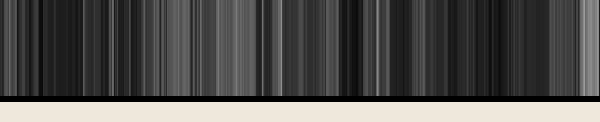
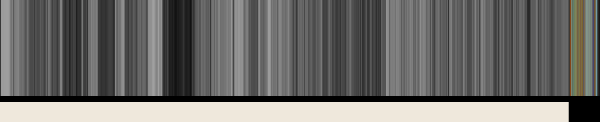
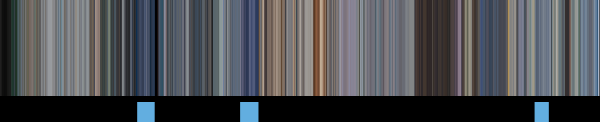
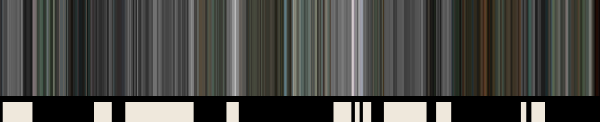
Here is each film whole, first frame on the left and last on the right, in the average color of each moment. The band under a strip marks the same stretches as the chart above. For five of the films that is the line between color and monochrome. For Solaris and The Sacrifice it is less than that, for reasons each gets to below.
Ivan’s Childhood 1962
100% black and white
Andrei Rublev 1966
95% black and white
Solaris 1972
at least 8% tinted blue
Mirror 1975
39% black and white
Stalker 1979
43% sepia
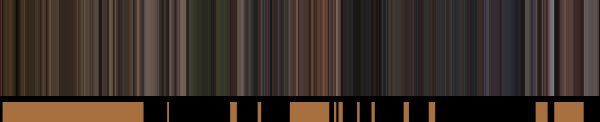
Nostalghia 1983
17% black and white
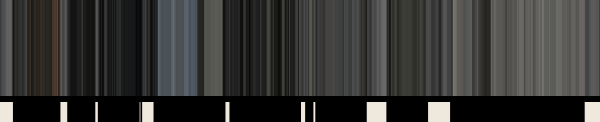
The Sacrifice 1986
54% nearly gray
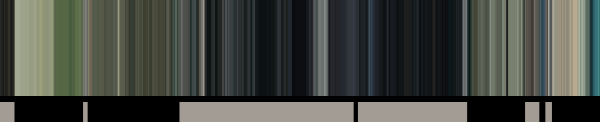
Black and white, then a color ending
Ivan’s Childhood is black and white for all of its 95 minutes. Andrei Rublev (1966) is black and white for 2 hours 53 minutes. Then comes its epilogue, in which the camera moves over the icons Rublev painted, and the film turns to color and stays there to the end: 9 minutes 32 seconds, 5% of the film.
That ending nearly escaped us. Our other posts leave out the last 6% of every film, because that is where the credits are. In Andrei Rublev the color begins 94.8% of the way through. So for this post we measured every film whole.
Mirror goes to black and white eleven times
Mirror (1975) is 39% black and white: 42 of its 107 minutes, in eleven stretches. The shortest lasts 51 seconds and the longest 12 minutes 12 seconds. Between them the film is in color, never for more than 17 minutes at a time. Its dream sequences are in black and white, and so is most of the newsreel footage it cuts in.
Stalker is sepia until the Zone
Stalker (1979) begins in sepia and stays in it for 38 minutes, until the three men ride into the Zone. At 0:38:42 it cuts to color. It goes back to sepia inside the Zone, for 11 minutes from 1:18:07, about halfway through, and for shorter stretches around that. And it ends by alternating: sepia for 3 minutes 14 seconds, color for 1 minute 47 seconds, sepia for 7 minutes 57 seconds, then color for the last 4 minutes 24 seconds. The color at the end goes with the scenes of the Stalker’s daughter.
In all, 43% of the film is sepia. That figure is less exact than the others. The Zone is full of rust, mud and brown water, which in color sit close to sepia, so the count moves between 42% and 46% as the line is drawn tighter or looser. The sepia is not one brown, either. In the copy we measured it is a yellow-brown at the start of the film and a red-brown at the end.
Nostalghia: color that our own rule takes for black and white
Nostalghia (1983) opens in black and white and closes in it, and goes back to it nine times in between: 17% of the film, 21 of its 126 minutes. The rest is in color, but only just. In its color scenes the main color of the frame has real color in it (a chroma over 6) for 13% of the seconds. In the other live-action color films of 1972 to 1986 in Fade to Color the figure is 56%.
We sort films into color and black and white by that share, with the line at 15%. Nostalghia falls on the black-and-white side of it, and would even if its black-and-white scenes were left out.
Solaris: black-and-white film, tinted blue
Solaris (1972) is one of two we can’t split. Parts of it were shot in black and white, but in the copy we measured almost nothing is gray: 0.4% of its seconds. The black-and-white scenes are tinted blue instead, and the tint is not the same from one scene to the next. Releases of the film differ on this. One showed these scenes in plain black and white, and a later one tinted them.
What we can point to is three long stretches where the whole frame holds one strong blue: the drive through the city, for 4 minutes 52 seconds from 0:38:07, then 5 minutes 6 seconds from 1:06:44 and 3 minutes 57 seconds from 2:28:35. Together they are 14 minutes, 8% of the film. The true share is higher. Scenes with a paler tint sit too close to the blue light of the space station for our numbers to tell film stock from lighting, so the band under Solaris marks only those three.
The Sacrifice: 70 minutes with the color taken out
The Sacrifice (1986) has black-and-white visions too, but its longer departure from color is its night. From 0:43:50 to 1:54:07, 70 minutes, the picture is close to gray. Its average color has a chroma of 3 there, against 13 in the 40 minutes before. Sven Nykvist, who shot the film, said that almost 60% of the color was taken out of some of its scenes.
In the copy we measured, the visions and the night around them both carry a faint tint, so our numbers can’t pull the two apart. The band under the strip marks every stretch that is nearly gray, whichever it is: 54% of the film. One stretch does stand alone: at 0:20:17, for 1 minute 7 seconds, the color drops out of the green of the film’s opening.
Few other films of those years do this
To see how rare the mixing is, take the rule that works for Mirror and Nostalghia, exact gray for at least 5% of a film and color for at least 5%, and run it over the 455 other live-action films of 1962 to 1986 in Fade to Color. 92 of them are black and white. Two pass the rule: Mishima: A Life in Four Chapters (1985) and the documentary The Times of Harvey Milk (1984). The rule can’t see sepia or tinted film, so it misses some, in Tarkovsky’s films and everyone else’s alike.
What color there is has little orange
Set the black and white aside and take the five films that have color in them. Orange is the commonest color in film: skin, lamps, wood, sunsets. It is the main color for 33% of the average live-action color film of 1972 to 1986, and for 7% of the average one of these five (p = 0.005). That is with Stalker’s sepia counted as orange. All five are below the other films’ average. The five are grayer as well, 62% against 44% (p = 0.04).
Green and blue run higher than in other films, but each is the doing of one film. In the copy of The Sacrifice we measured, the main color is a gray-green for 56% of the running time, and the other four films average 6%. Solaris is 33% blue, and the other four average 2%.
Every film’s color palette, with hex codes
These are the six main colors of each film, most common first, with their hex codes. They come from the main color of each second, sorted into six groups of similar color. Each chip is the most typical color of its group. Under each title are the film’s shares of green, blue, orange and gray. The palettes leave out the first 4% and last 6% of each film, as in our other posts, which is why Andrei Rublev’s has no color in it.
Ivan’s Childhood 1962
0% green · 0% blue · 0% orange · 100% gray
- #1C1C1C
- #282828
- #3D3D3D
- #5A5A5A
- #7F7F7F
- #C6C6C6
Andrei Rublev 1966
0% green · 0% blue · 0% orange · 100% gray
- #2D2D2D
- #1F1F1F
- #3E3E3E
- #595959
- #7A7A7A
- #9F9F9F
Solaris 1972
3% green · 33% blue · 10% orange · 39% gray
- #252425
- #232E3F
- #86878A
- #556172
- #51433A
- #BDB5A2
Mirror 1975
9% green · 1% blue · 2% orange · 78% gray
- #21201D
- #2F3330
- #4D5151
- #818181
- #D0D0D0
- #945E23
Stalker 1979
5% green · 0% blue · 18% orange · 70% gray
- #221B18
- #1E1C1E
- #2E2721
- #1D1F17
- #3E3027
- #6C554C
Nostalghia 1983
6% green · 2% blue · 3% orange · 89% gray
- #20211E
- #343633
- #535453
- #5C6369
- #261C12
- #432C18
The Sacrifice 1986
56% green · 3% blue · 1% orange · 33% gray
- #19211E
- #252F28
- #526843
- #3D4939
- #5E6254
- #989A82
How we measured it
The seven films are Tarkovsky’s features. His three student shorts and the documentary Voyage in Time (1983) are not counted. For the line between color and monochrome we took two colors from every second of every film, first second to last: the frame’s average color and its main color. That is 16 hours 26 minutes of film.
What monochrome looks like depends on the copy, so the rule is set film by film. In Ivan’s Childhood, Andrei Rublev, Mirror and Nostalghia the black and white is exact gray. There a second is black and white when both colors sit within 0.3 CIELAB units of gray and most of the nine seconds around it do too. The limit is that tight because the color scenes of Nostalghia are within one to three units of gray themselves. A stretch counts when it lasts ten seconds or more.
In Stalker a second is sepia when its average color is a warm brown (a hue of 26° to 80°) with a chroma of at least 0.3 of its lightness, and its main color is a warm brown too when it is light enough to tell. A bright second, where the tone is weaker, counts when its main color is strongly toned. A stretch counts when it lasts 30 seconds or more. In Solaris we marked stretches of 90 seconds or more in which both colors are the same strong blue. In The Sacrifice we marked stretches of a minute or more in which the chroma of the average color, as a median over a minute, stays under 6.
The palettes and the comparison with other films are measured as in our other posts: the main color of each second, leaving out the first 4% and last 6% of the film and anything close to black. A second is gray when its chroma is under 6. Otherwise it is one of seven colors by hue: red (0° to 35°), orange (35° to 85°), yellow (85° to 110°), green (110° to 170°), teal (170° to 220°), blue (220° to 290°), or purple and pink (290° to 360°). The p-values come from a permutation test on the difference between two averages.
The versions: Andrei Rublev at 183 minutes, which is the final cut and not the 205-minute first one, Solaris at 167, Mirror at 107, Stalker at 162, Nostalghia at 126 and The Sacrifice at 147, all in high definition and standard dynamic range.
The limits: two colors a second can’t see a frame that is half color and half gray. The lines are drawn on the copies we have, and another transfer can move them, in Solaris most of all. And the comparison films lean toward well-known titles.
| Film | Length | Not in full color | As |
|---|---|---|---|
| Ivan’s Childhood 1962 | 95 min | 100% | black and white |
| Andrei Rublev 1966 | 183 min | 95% | black and white |
| Solaris 1972 | 167 min | 8% or more | tinted blue |
| Mirror 1975 | 107 min | 39% | black and white |
| Stalker 1979 | 162 min | 43% | sepia |
| Nostalghia 1983 | 126 min | 17% | black and white |
| The Sacrifice 1986 | 147 min | 54% | nearly gray |
See any film’s colors
Fade to Color shows thousands of films as their colors, from the first frame to the credits, including all seven of these. Scrub through one scene by scene, draw it as a spiral or ripples, or guess films from their colors alone.